Pneumatic Rubber Fenders
ISO 17357 Yokohama-type floating fenders for ship-to-ship & berthing
Overview
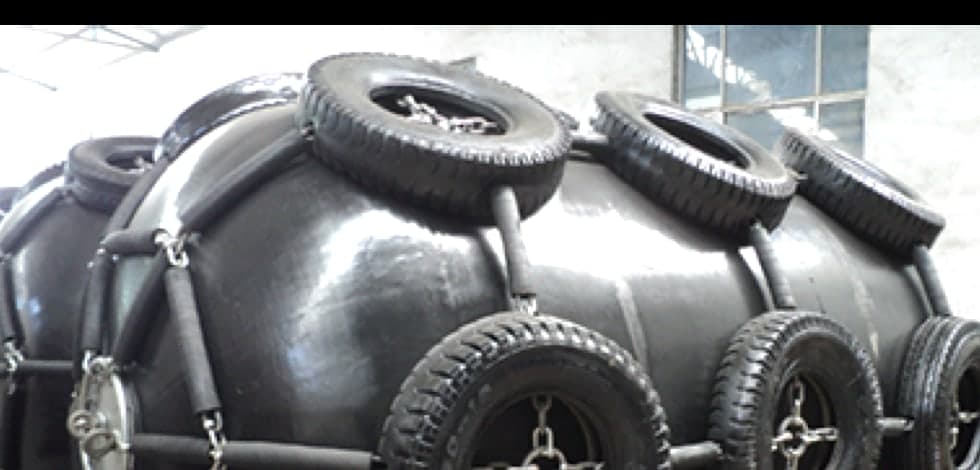
A pneumatic rubber fender is a floating, air-filled fender — one of the most widely used anti-collision devices in the marine industry. It is built from synthetic-nylon-reinforced compressed rubber sheet and floats on the water on the compressed air sealed inside its body.
Because it compresses that trapped air on impact, a pneumatic fender absorbs a large amount of berthing energy while keeping the reaction force — the unit pressure acting on the hull — low. That combination makes it the standard protecting medium for ship-to-ship transfer and for berthing large vessels.
How it works
On contact the fender deflects and the sealed air compresses; the pressure rises smoothly with deflection, absorbing the vessel's kinetic energy and spreading the load over a large contact area. ISO 17357-1 defines the guaranteed energy and reaction force for each size at 50 kPa and 80 kPa initial pressure.
A chain-and-tyre net is usually fitted over the rubber body for abrasion protection and to spread point loads during heavy-duty berthing.
Why it's used
- High energy absorption at low hull pressure
- Floats and follows the tide — no fixed mounting
- Ideal for ship-to-ship (STS) transfer
- Chain-tyre net option for heavy-duty service
- Weather-, ozone- and aging-resistant rubber
The rubber is graded to marine standards — outer rubber tensile strength ≥18 MPa, elongation ≥400%, with ozone- and heat-aging resistance — so the fender holds its performance through years of exposure. Size (diameter × length, from 0.5 × 1.0 m up to 4.5 × 12 m) and initial pressure are matched to the berthing energy.
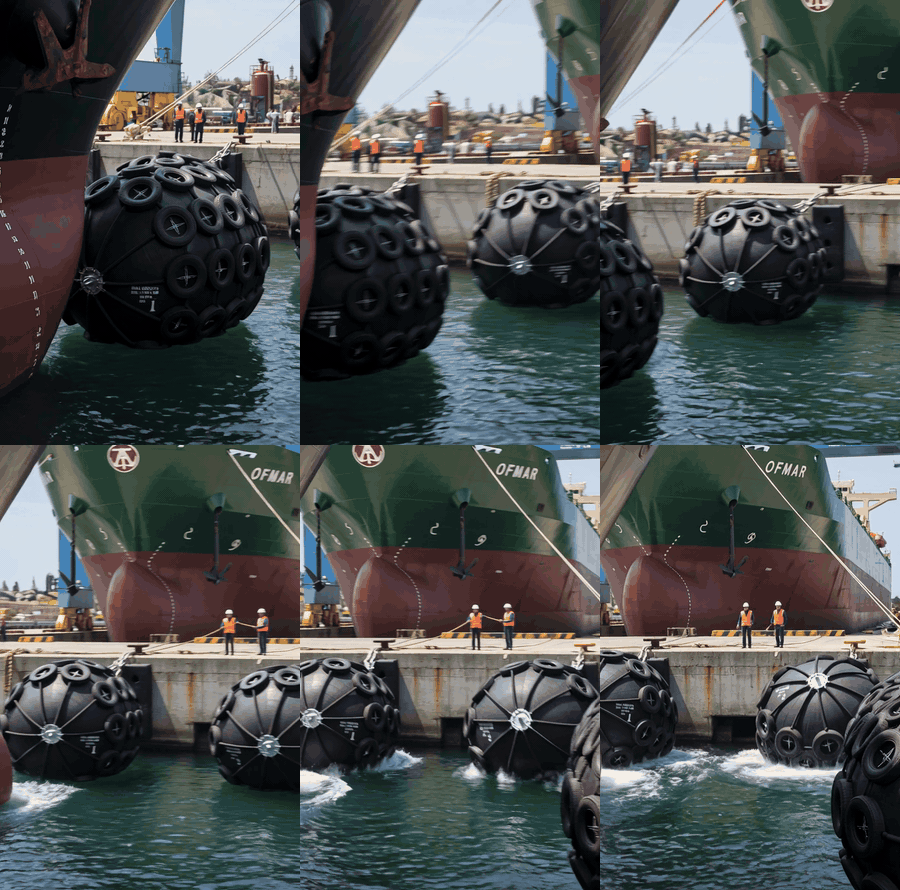
An AI-reimagined berthing on a Yokohama pneumatic fender — big energy in, soft landing out.
Typical applications
- Ship-to-ship (STS) transfer
- Large tankers & LPG carriers
- Bulk carriers & ocean platforms
- Floating construction units
- Large docks & harbours
Need this sized for a vessel?
Send the vessel data and get the relevant specification and standards back.
Start an enquiryQuestions & answers
How does Pneumatic Rubber Fenders work?
On contact the fender deflects and the sealed air compresses; the pressure rises smoothly with deflection, absorbing the vessel's kinetic energy and spreading the load over a large contact area. ISO 17357-1 defines the guaranteed energy and reaction force for each size at 50 kPa and 80 kPa initial pressure. A chain-and-tyre net is usually fitted over the rubber body for abrasion protection and to spread point loads during heavy-duty berthing.
Where are Pneumatic Rubber Fenders used?
Ship-to-ship (STS) transfer, Large tankers & LPG carriers, Bulk carriers & ocean platforms, Floating construction units, Large docks & harbours
Which standards apply to Pneumatic Rubber Fenders?
Manufactured and evaluated to ISO 17357, PIANC 2002, Bureau Veritas
More equipment
Imagery & technical data referenced from max-groups.com