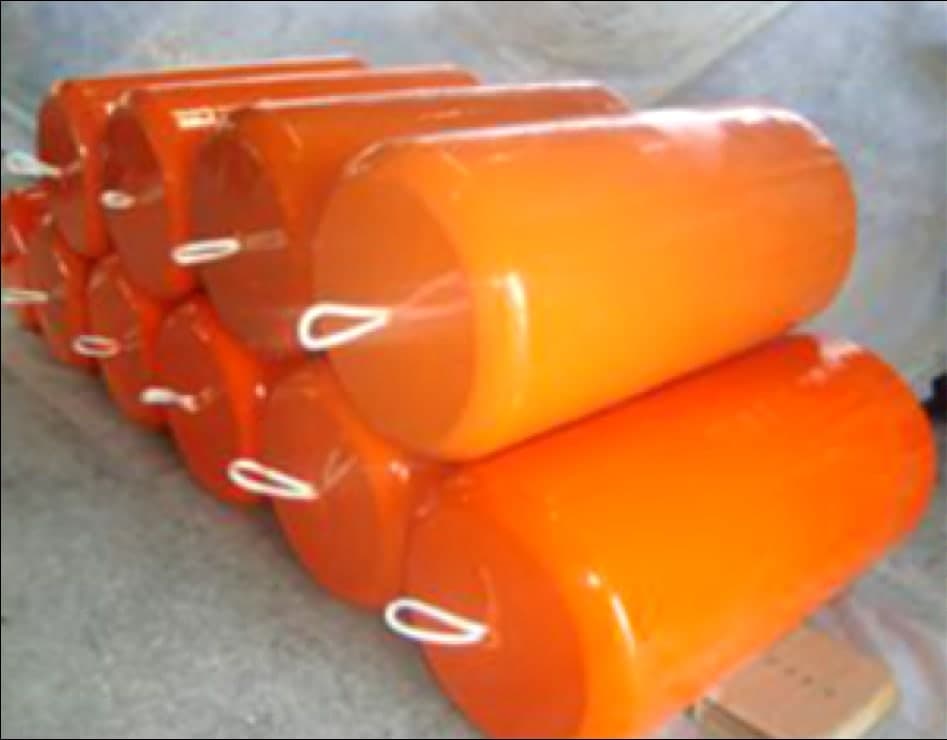
Foam-Filled Fenders
Unsinkable closed-cell foam fenders for continuous, high-exposure duty
Overview
A foam-filled fender is a solid, closed-cell foam core wrapped in a reinforced elastomer skin. Unlike a pneumatic fender it holds no air pressure, so it cannot be punctured flat — even if the outer skin is cut, the closed-cell foam keeps the fender buoyant and working. That makes it the low-maintenance choice for permanent, high-exposure berths.
Inside the skin sit an internal steel core and mounting flange, wrapped by a reinforcement cord layer and the buoyant foam. The result absorbs berthing energy the way a pneumatic fender does, but is effectively unsinkable and tolerant of damage.
How it works
On impact the foam core and elastomer skin compress and spread the load. The fender is normally rated at 60% deflection, and its reaction force and energy absorption follow published performance curves (tolerance about ±15%).
Foam fenders float and follow the tide, so they are hung or moored against a quay or slung between vessels. The supporting structure only has to cope with the tide range and the fender's footprint when compressed.
Why it's used
- Unsinkable — works even if the skin is cut
- No internal air pressure to maintain
- Floats and follows the tide
- Tough, abrasion- and UV-resistant skin
- Low maintenance for permanent berths
The core is EVA closed-cell foam (closed-cell rate over 95%, density ~100–110 kg/m³) and the skin is a high-strength elastomer (tensile ≥18 MPa, ~80 Shore A) — chosen so the fender keeps absorbing energy through years of continuous contact.
Typical applications
- Ship-to-ship transfer
- Permanent & exposed berths
- Offshore & platform fendering
- Barge & pontoon protection
- Marker & navigation buoyancy
Need this sized for a vessel?
Send the vessel data and get the relevant specification and standards back.
Start an enquiryQuestions & answers
How does Foam-Filled Fenders work?
On impact the foam core and elastomer skin compress and spread the load. The fender is normally rated at 60% deflection, and its reaction force and energy absorption follow published performance curves (tolerance about ±15%). Foam fenders float and follow the tide, so they are hung or moored against a quay or slung between vessels. The supporting structure only has to cope with the tide range and the fender's footprint when compressed.
Where are Foam-Filled Fenders used?
Ship-to-ship transfer, Permanent & exposed berths, Offshore & platform fendering, Barge & pontoon protection, Marker & navigation buoyancy
Which standards apply to Foam-Filled Fenders?
Manufactured and evaluated to PIANC 2002, Bureau Veritas, CCS
More equipment
Imagery & technical data referenced from max-groups.com