Fender size starts from berthing energy, never from the catalogue. Work the energy first, then pick a fender with margin — with the reaction force and hull pressure checked at the same time.
Start from berthing energy
The fender does not care how big the ship is — it cares how much kinetic energy arrives at the moment of contact. That energy is E = ½ · M · V² · Ce · Cm · Cs · Cc: displacement mass and approach velocity do the heavy lifting, adjusted by the eccentricity, added-mass, softness and berth-configuration coefficients from ISO 17357. Get the approach velocity right and you are most of the way there; guess it low and every fender downstream is undersized.
A worked example
Take a 50,000-tonne-displacement tanker berthing at a modest 0.12 m/s. The raw ½MV² is about 360 kJ. Apply a typical eccentricity of 0.6 and an added-mass factor around 1.4 — softness and configuration near 1.0 for an open ship-to-ship transfer — and the design energy lands near 300 kJ per fender contact.
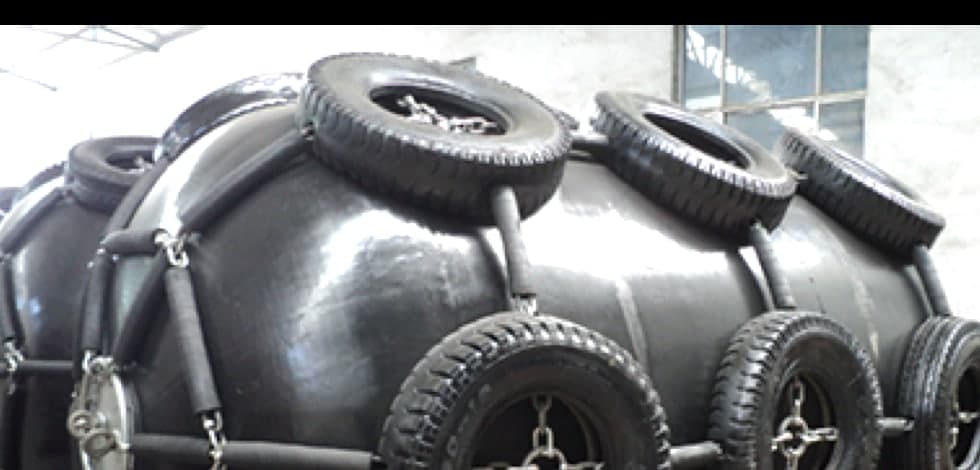
Now pick a fender rated comfortably above 300 kJ, not exactly at it: sea state, an off-angle approach and a heavier day all eat margin. A 3.3 m × 6.5 m pneumatic fender at 50 kPa initial pressure sits in that band. Confirm against the manufacturer's own energy/reaction curve before you commit — these figures illustrate the method, not your berth.
Reaction force and hull pressure decide the rest
Energy absorption is only half the selection. The reaction force the fender pushes back with, and the resulting pressure on the hull plating, set whether a fender that absorbs enough will also be kind to the ship. Pneumatic fenders shine here — high absorption at comparatively low reaction — but a larger diameter spreads the load and drops hull pressure further. Where the hull has a stated maximum allowable pressure, that limit, not the energy, often chooses the final size.